
Ultimate Guide to Real-Time Abuse Detection
Real-time abuse detection blocks fraud, spam, and account takeovers by scoring behavior and acting in milliseconds to stop losses and protect user experience.
Real-time abuse detection is critical for protecting businesses from fast-evolving threats like fraud, spam, and account takeovers. With U.S. businesses losing $8.8 billion to fraud in 2022 - a 30% increase from the prior year - traditional systems can't keep up. Real-time systems analyze data in milliseconds, identifying suspicious activities and triggering automated responses to mitigate risks immediately.
Key takeaways:
- Speed matters: Fraud can cause massive losses within minutes. Real-time detection reduces fraud losses by 30–50%.
- How it works: Combines data collection, stream processing, and risk scoring to flag threats instantly.
- Core targets: Protects web apps, APIs, payment systems, and account registrations from attacks like credential stuffing and fake accounts.
- Proven results: Companies like Ramp cut detection times from hours to seconds, reducing account takeover incidents by 60%.
- Advanced techniques: Moves beyond static rules to behavioral detection, anomaly detection, and AI-driven risk scoring for greater accuracy.
Real-time abuse detection systems are essential for staying ahead of fraudsters, safeguarding transactions, and reducing operational costs.
Core Components of Real-Time Detection Systems
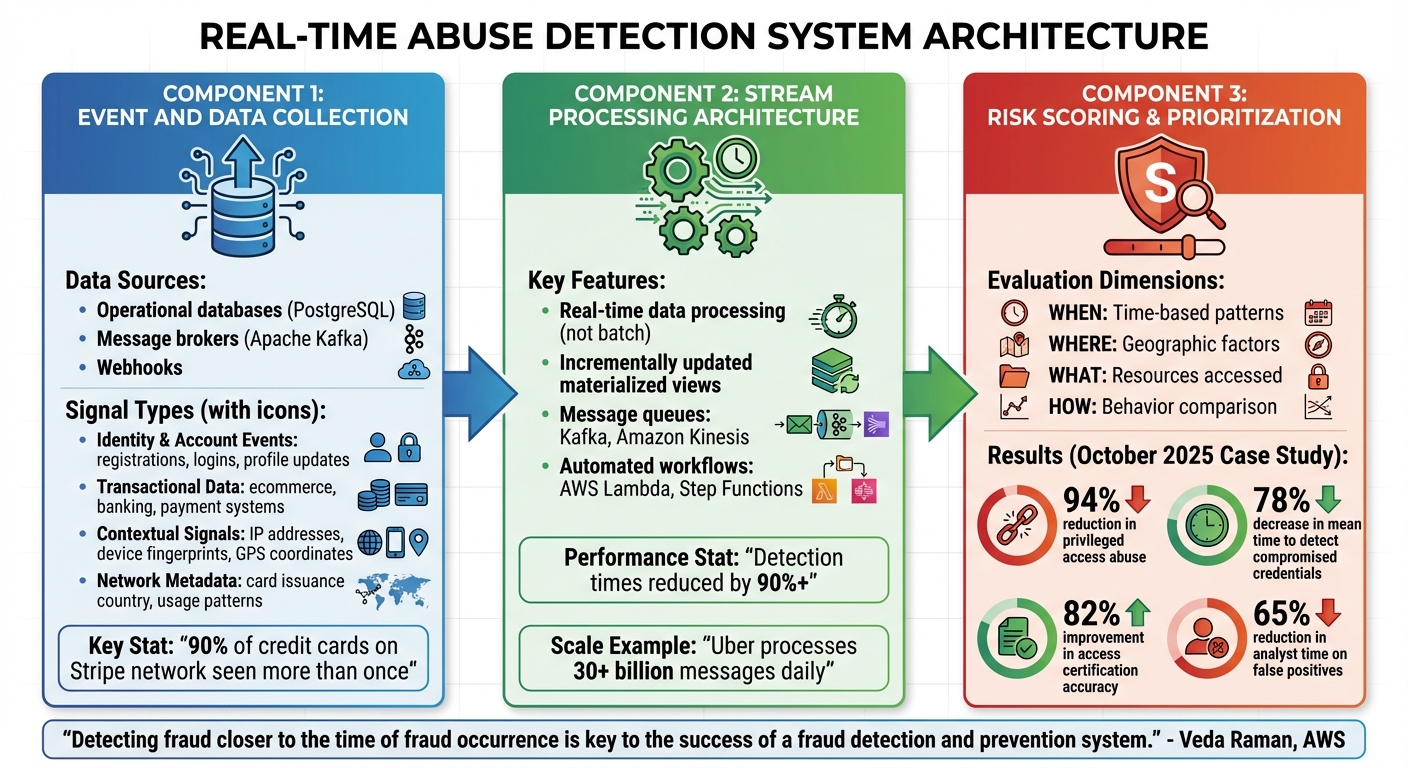
Real-Time Abuse Detection System Architecture and Components
Creating a real-time abuse detection system hinges on three key components: data collection, stream processing, and risk scoring. Each element plays a crucial role in identifying threats before they can cause harm.
Event and Data Collection
The foundation of any effective detection system is collecting data from the right sources. This involves pulling information from operational databases like PostgreSQL, message brokers such as Apache Kafka, and webhooks that capture events as they occur. To get a complete picture of user behavior, it's essential to gather diverse signals.
Identity and account events are at the heart of detection efforts. These include activities like new account registrations, login attempts, and profile updates - such as changes to addresses, phone numbers, or payment methods. Transactional data from ecommerce, banking, or payment systems provides real-time insights into unusual spending patterns. Additionally, contextual signals like IP addresses, device fingerprints, and GPS coordinates can help uncover anomalies, such as instances of impossible travel. Network-level metadata, such as the country where a card was issued and how many countries it's been used in within a short period, adds yet another layer of perspective.
"Detecting fraud closer to the time of fraud occurrence is key to the success of a fraud detection and prevention system." - Veda Raman, Senior Specialist Solutions Architect for Machine Learning, AWS
One major advantage of integrated systems is their ability to leverage historical context. For instance, 90% of credit cards used on the Stripe network have been seen more than once, enabling deeper analysis than isolated systems can achieve. By embedding detection capabilities directly into payment or application flows, systems can access "ground truth" labels - like whether a transaction resulted in a dispute - without relying on manual labeling. Once the data is collected, it moves into the next phase: real-time processing.
Stream Processing Architecture
Stream processing is the backbone of real-time detection. Unlike batch processing, which works on data in intervals, stream processing handles data as it’s generated, enabling near-instant detection of suspicious activities. Modern systems use incrementally updated materialized views, which refresh only the data that has changed. This approach minimizes processing delays and reduces compute costs.
These architectures often rely on message queues like Kafka or Amazon Kinesis to trigger automated workflows. For example, AWS Lambda or Step Functions can be used to block or flag transactions in real time, stopping fraud before it escalates. Some fintech companies have shown that switching to real-time streaming architectures can reduce detection times by over 90%.
A standout example is Uber, which processes over 30 billion messages daily using Apache Kafka. This setup supports fraud and anomaly detection by integrating GPS data streams with ride-matching algorithms to identify unusual patterns of behavior. To ensure scalability, it’s important to decouple the ingestion and analysis layers using a dedicated streaming platform. Materialized views can store cached snapshots of risk scores, avoiding the need for repeated complex computations with every query. With data processed in real time, the next step is to assess and prioritize risk effectively.
Risk Scoring and Prioritization
After collecting and processing data, the system must assign risk scores to accounts, sessions, and IP addresses to prioritize responses. Modern systems move beyond static reviews, instead using continuous evaluation to assess risk in real time as user behavior and environmental factors evolve.
Effective risk scoring involves establishing behavioral baselines across multiple dimensions: when access typically occurs (time-based patterns), where it originates (geographic factors), what resources are accessed, and how user behavior compares to similar entities. These baselines are adjusted based on factors like resource sensitivity, user privileges, and the current business context.
In October 2025, a global financial services organization adopted Avatier's AI-driven risk scoring and Identity Management solutions. The results were striking: a 94% reduction in privileged access abuse incidents, a 78% decrease in the mean time to detect compromised credentials, an 82% improvement in access certification accuracy, and a 65% reduction in analyst time spent investigating false positives.
To keep systems effective, it’s crucial to address model drift by regularly validating and retraining machine learning models. Attack methods evolve quickly, and even a model from a month ago can lose its edge. Additionally, systems should provide clear documentation of the factors influencing risk scores. This transparency not only supports compliance but also builds trust with users.
Detection Techniques and Methods
After collecting data and assigning risk scores, the next step in effective abuse detection is choosing the right technique. Real-time detection often relies on rule-based, anomaly, and behavioral methods to quickly identify and address suspicious activity, minimizing the impact of abuse.
Rule-Based vs. Behavioral Detection
Rule-based systems operate on straightforward logic, like blocking requests from an IP address if they exceed a set threshold. While these systems are fast and easy to understand, they struggle to keep up with evolving threats. Attackers can bypass static rules by using tactics like IP rotation or throttling requests just below the detection limits. For instance, a 2023 study on financial APIs found that rule-based systems failed to catch 78% of credential stuffing attempts because attackers stayed within predefined thresholds.
Behavioral detection offers a more dynamic approach. Instead of trying to predict every possible attack, machine learning models analyze normal traffic patterns and flag deviations as suspicious. This flexibility is essential for handling complex API endpoints with multiple request types and dimensions, where the number of potential attack scenarios can become unmanageable.
| Feature | Rule-Based Detection | Behavioral Detection |
|---|---|---|
| Detection Logic | Static thresholds | Statistical baselines |
| Maintenance | Manual updates for threats | Retrains on new data |
| Threat Type | Known threats | Unknown/polymorphic threats |
| False Positives | High during traffic spikes | Adapts to behavior changes |
A notable example is Meta’s Predictive Response Optimization (PRO) system, deployed in February 2025 on Instagram and Facebook. This reinforcement learning-based system replaced static rules to combat automated scraping. On Instagram, it cut abuse volume by 59% without disrupting legitimate users. The system predicts actions like showing CAPTCHAs or disabling accounts to balance harm prevention with user experience.
"The goal [is] selecting actions (e.g., ban the user, block the request, show a CAPTCHA, or 'collect more evidence') that optimize a tradeoff between harm caused by abuse and impact on benign users".
To fine-tune detection systems, teams often start with a "log mode" to calibrate models and reduce false positives. Many also adopt ensemble methods, combining techniques like Isolation Forests for anomaly detection and Gradient Boosted Trees for classification. This approach improves detection accuracy while minimizing alert fatigue.
Building on these foundations, anomaly detection takes threat identification to the next level by measuring deviations from expected behavior.
Real-Time Anomaly Detection
Anomaly detection enhances behavioral methods by using statistical tools to spot outliers. It works by establishing a baseline of "normal" behavior for users, devices, or API endpoints and flagging deviations in real time. Systems analyze transactions, logs, and API calls against these baselines to detect irregularities as they happen.
Popular techniques include:
- Mahalanobis distance: Measures how many standard deviations an event deviates from the mean.
- Isolation Forests: Identifies anomalies by isolating them in feature space.
- Autoencoders: Detect anomalies by measuring how well a model can reconstruct normal behavior.
Advanced deep learning models, such as LSTMs and Transformers, can recognize sequential patterns and predict legitimate actions. Requests with low probabilities are flagged as suspicious.
Key features for anomaly detection include velocity (frequency of actions), location anomalies (e.g., impossible travel between geographic locations), and device fingerprints. For example, if a user logs in from New York at 2:00 PM and attempts a transaction from London 30 minutes later, the system flags this as suspicious.
In 2023, fintech company Ramp transitioned from batch fraud detection to a real-time operational data warehouse. This upgrade reduced the time to detect account takeover (ATO) attacks from over an hour to just 1–3 seconds. The result? A 60% drop in successful ATO attacks and automatic flagging of 50% of compromised accounts without extra operational costs.
To maintain low latency, real-time systems should rely on operational data warehouses with incremental updates to materialized views instead of full dataset refreshes. Monitoring P50, P95, and P99 latencies ensures the detection engine stays within the 100–300ms range needed for smooth user experiences. Transformer-based models have demonstrated F1 scores of 92-96% on API abuse detection benchmarks, with inference times under 5ms.
For even more context-aware detection, User and Entity Behavior Analytics (UEBA) adds another layer of sophistication.
User and Entity Behavior Analytics (UEBA)
UEBA goes beyond anomaly detection by analyzing both user and entity behaviors. It creates dynamic baselines for entities like employees, servers, or service accounts, monitoring variables such as login times, geographic locations, accessed assets, and data transfer volumes.
This approach identifies subtle threat signals, such as indicators of compromise (IoC) or attack (IoA), that traditional rule-based systems might overlook. For instance, UEBA can detect a user who suddenly accesses an unusually high number of files, logs in from a new country, or transfers data volumes far beyond their historical average.
Microsoft Sentinel, for example, uses an "Investigation Priority Score" ranging from 0 to 10 to help analysts focus on high-risk activities. Many UEBA systems also incorporate peer group analysis, comparing a user’s behavior against colleagues in similar roles to determine whether an action is genuinely anomalous.
To reduce false positives, it’s crucial to implement data sufficiency filters that ensure enough historical data exists (e.g., at least 9 of the last 30 days) before triggering alerts. Additionally, stability filters - using metrics like the Coefficient of Variation (CV) - help distinguish between stable entities (e.g., servers) and noisy ones (e.g., laptops), reducing unnecessary alerts from erratic behavior.
Security teams can also combine "weak signals" into a single high-priority alert. For example, an anomalous login followed by unusual API access and data staging can be linked into a cohesive attack narrative. This method streamlines investigations and ensures teams focus on real threats rather than isolated anomalies.
Building a Real-Time Abuse Detection System
Creating a system that processes events and responds in milliseconds demands a well-thought-out design. The architecture must prioritize speed, accuracy, and efficiency to handle thousands of transactions per second seamlessly.
System Architecture Overview
A real-time abuse detection system typically includes four key layers:
- Data Ingestion Layer: This layer collects transaction or event data. Tools like Apache Kafka, Amazon Kinesis, or Redpanda are commonly used to manage high-throughput event streams, ensuring no data is lost, even during traffic surges.
- Processing Layer: Here, raw data is transformed into actionable insights. Unlike traditional batch-processing data warehouses, platforms such as Materialize, Tinybird, and Apache Flink enable real-time data processing with sub-second latency. These systems use incrementally updated materialized views to refresh only changed data, cutting down on compute costs while maintaining speed.
- Scoring and Analysis Layer: This layer applies SQL-based rules or machine learning models to evaluate risk. For example, it might flag unusual activity like 50 login attempts within 60 seconds or sudden access from a distant location. Stripe's fraud detection system, for instance, leverages the insight that 90% of credit cards on their platform have been seen more than once, improving detection accuracy.
-
Action and Response Layer: This layer provides APIs to automate responses, such as blocking transactions, flagging accounts, or sending alerts. As Joe Karlsson from Tinybird explains:
"A popular way to expose fraud detection analysis is through APIs that can be consumed by both visualization tools and automated software processes".
| Component | Recommended Tools | Purpose |
|---|---|---|
| Ingestion | Kafka, Kinesis, Redpanda | High-throughput event streaming |
| Processing | Materialize, Tinybird, Flink | Real-time SQL transformation |
| Storage | DynamoDB, S3, Snowflake | Persistence and historical analysis |
| Orchestration | AWS Step Functions, Lambda | Workflow automation and API calls |
| Visualization | Retool, Tableau, Looker | Monitoring trends and manual triage |
A well-structured system like this can also integrate external abuse intelligence to enhance detection capabilities.
AbuseReport.org Integration

Adding specialized platforms, such as AbuseReport.org, can complement your system's core functions. AbuseReport.org offers API-first solutions for email validation, IP reputation checks, VPN/proxy detection, and abuse data lookups.
- Synchronous Workflows: Use the AbuseReport.org API during critical events like account creation or transactions. For example, if an email fails MX, SPF, or DMARC validation - or if an IP address has a history of abuse - you can block the action instantly.
- Asynchronous Workflows: For non-urgent checks, use webhooks to enrich data without delaying user transactions. After a user registers, for instance, a background job could verify their IP against AbuseReport.org's VPN/proxy detection service. This method avoids impacting the primary flow while still enhancing your data.
AbuseReport.org also supports session-based detection, which validates tokens or cookies instead of relying solely on IP addresses. This reduces false positives, especially in environments like corporate networks or public Wi-Fi, where multiple users share the same IP. Rate-limiting strategies can be tailored using JWT claims, such as userEmail or user_tier, to set thresholds for free versus premium users.
To simplify integration, the platform offers SDKs for PHP, Python, and JavaScript. For no-code environments, it provides integrations with tools like Stripe and PayPal for dispute reporting, as well as a Telegram bot for instant alerts. Additionally, AbuseReport.org's Labels API allows you to send feedback about flagged users, helping refine its risk models over time.
Deployment Best Practices
Deploying a real-time detection system requires careful planning to strike a balance between catching malicious activity and maintaining a smooth user experience.
- Start by running new rules in log mode. Instead of blocking actions immediately, log violations to monitor for false positives and fine-tune thresholds. For example, if testing a rule that blocks accounts with over 10 failed login attempts in 5 minutes, observe its impact in log mode for a week.
- Use asynchronous processing for time-intensive checks that exceed typical API timeout limits (usually 29 seconds). For tasks like deep packet inspection or complex machine learning inference, an event-driven architecture using AWS Lambda or similar tools can handle workloads of up to 15 minutes. Failed events can be archived in systems like Amazon EventBridge for later troubleshooting.
- Validate inputs at multiple levels and segment traffic based on user history. Stricter checks should apply to new accounts with no transaction history, while established users with clean records may require less scrutiny. Assign confidence scores to automated recommendations, and rely on manual review for high-variability endpoints until accuracy improves.
- Ensure critical inline checks are fast - ideally completing within 100–300ms - to avoid disrupting the user experience. If response times increase, consider moving non-critical steps to asynchronous workflows or scaling infrastructure accordingly.
Finally, build feedback loops into your system. As Veda Raman from AWS emphasizes:
"Detecting fraud closer to the time of fraud occurrence is key to the success of a fraud detection and prevention system".
Regularly update your models to stay ahead of evolving fraud tactics.
Operations and Governance
Once your real-time detection system is up and running, the focus shifts to keeping it reliable, efficient, and compliant. Interestingly, about 70% of the costs tied to security systems come after deployment. These expenses cover everything from maintenance to monitoring and updates. Without proper oversight, even the most advanced system can become a source of frustration, generating too many false positives.
Alert Triage and Response Workflows
Every alert needs a clear, actionable path from detection to resolution. Start by centralizing your telemetry - combine logs from email, endpoints, cloud platforms, and SaaS tools into a unified data lake. This setup eliminates blind spots and allows analysts to act quickly during investigations. To streamline responses, use Security Orchestration, Automation, and Response (SOAR) tools. These tools can automate repetitive tasks like gathering threat intelligence and assessing asset sensitivity.
For recurring high-risk scenarios - like credential stuffing or account takeovers - create standardized playbooks. These guides, kept up to date with version control, should outline triggers, queries, and necessary actions, saving your team from starting from scratch every time. For critical threats, automate actions such as disabling compromised tokens, revoking access, or isolating affected devices. As Andrew Wung from Abusix aptly puts it:
"In cybersecurity, time isn't just money - it's survival".
Define clear escalation tiers and establish on-call rotations so Security, IT, and Legal teams know exactly what to do during major incidents.
Keep an eye on metrics like Mean Time to Detect (MTTD) and Mean Time to Respond (MTTR). These numbers highlight bottlenecks in your triage process and help track improvements. Advanced anomaly detection systems have helped organizations reduce security breaches by 85%, with live threat detection saving an average of $3.2 million in potential breach costs. Use insights from investigations to fine-tune your detection models, cutting down on noise and false positives over time.
Once your response workflows are solid, the next challenge is keeping your detection models aligned with emerging threats.
Monitoring and Model Updates
With alert triage running smoothly, the next step is to ensure your detection models remain effective as threats evolve. Static models can quickly become outdated. For example, a 2023 study on financial APIs found that rule-based systems failed to catch 78% of credential stuffing attempts because attackers used techniques like IP rotation and request throttling. To counter this, consider using online learning algorithms such as Stochastic Gradient Descent (SGD), which allows models to update incrementally as new data comes in. Automated drift detection can also signal when it’s time for a full model retraining.
Revisit your threat assumptions and detection rules quarterly. Focus on the threats most relevant to your business - whether that’s SaaS data theft or payment fraud - instead of chasing every possible indicator. For example, a major payment processor achieved a 72% drop in fraudulent transactions by deploying an AI system that evaluates over 400 features per API call. To manage costs while maintaining fast response times, use materialized views that refresh incrementally.
Privacy and Compliance
Ensuring your system works well also means prioritizing privacy and compliance. Handling telemetry and user data requires strict governance. Implement Just-In-Time (JIT) access controls so human reviewers can only access flagged content through Secure Access Workstations (SAWs) with managerial approval. For resources tied to specific regions, ensure that only authorized reviewers within those regions handle the data to meet local privacy laws.
Offer options like Modified Abuse Monitoring or opt-out features for customers with highly sensitive data. This allows them to bypass human review and data storage. If AI models are used to confirm abuse, make sure the data isn’t stored or used for future training. Establish transparent notification processes: notify customers of any abuse determinations via email, and give them a chance to explain or resolve the situation before taking further action. Use data classification, encryption, and anonymization at the network perimeter to safeguard sensitive information and minimize risk.
Despite a 167% increase in API counts in 2024, only 58% of organizations have formal procedures for API discovery. Building governance into your operations from the start ensures your system stays effective, meets compliance standards, and earns the trust of your team and users alike.
Conclusion
Real-time abuse detection has become a cornerstone for safeguarding platforms, users, and revenue streams. With fraud losses climbing by 30%, amounting to billions of dollars at risk, the stakes couldn't be higher. The ability to detect abuse within milliseconds instead of hours can mean the difference between blocking a fraudster in their tracks or watching them make off with thousands of dollars.
The best systems combine rule-based engines with machine learning that adapts over time. Companies using real-time monitoring have reported cutting fraud losses by 30–50% compared to traditional batch-processing methods. These systems also deliver impressive financial benefits, with potential ROI reaching up to 285% while slashing manual review times by 80%.
"Real-time fraud detection is no longer a 'nice to have' - it's fundamental to safeguarding transactions, reputations, and revenue." - Youverify
This highlights the importance of immediate detection for every transaction.
Speed is non-negotiable, especially as consumers now expect instant approvals. Blocking legitimate transactions by mistake could result in losing 33% of customers. Real-time systems address this by performing risk assessments in as little as a fraction of a second, up to three seconds. This ensures genuine transactions proceed seamlessly, while suspicious ones are stopped before they can cause harm.
To stay ahead, continuous improvement is key. Fraud tactics evolve rapidly, rendering static rules ineffective. Systems equipped with online learning algorithms and automated retraining can adapt without requiring constant manual intervention. Strong governance practices - such as just-in-time access controls, compliance with regional regulations, and clear user notifications - help build trust. Start with small updates, establish behavioral baselines for each endpoint, and test new rules in a log-only mode before rolling them out.
FAQs
How do real-time abuse detection systems help prevent fraud and reduce losses?
Real-time abuse detection systems work around the clock, scanning data streams to spot and deal with suspicious activity the moment it occurs. By identifying potential fraud early, businesses can act fast to block or flag harmful behavior before it escalates.
This swift action can cut financial losses by 30–50%, a significant improvement over older, batch-processing methods. These systems also streamline operations, offering stronger protection against fraud, spam, and other digital threats.
What are the key components of a real-time abuse detection system?
A real-time abuse detection system operates by tracking, analyzing, and responding to user activity as it unfolds. Here’s how its key components function:
- Data ingestion: Rapidly collects user activity data, such as API calls or transaction logs, as they occur in real time.
- Processing and scoring: Examines incoming data streams using predefined rules or machine learning algorithms to pinpoint suspicious activities.
- Action and response: Employs automated tools, like APIs, to take swift action - blocking users or flagging questionable behavior immediately.
- Monitoring and feedback: Utilizes dashboards and alerts to help teams oversee activity and refine detection models over time.
Together, these components work seamlessly to detect and address abuse instantly, safeguarding systems and maintaining smooth user experiences.
What’s the difference between behavioral detection and rule-based systems for identifying threats?
Behavioral detection leverages machine learning and statistical techniques to analyze typical patterns in user behavior, device activity, or transactions. When something deviates from the norm, it raises a flag, potentially signaling abuse. What sets these systems apart is their ability to learn and adjust in real-time, using fresh data to spot new types of threats. By factoring in elements like context, speed, and past behavior, they also help cut down on false alarms.
In contrast, rule-based systems operate on fixed, predefined rules. For instance, they might block transactions exceeding $5,000 or deny access from specific blacklisted IP addresses. While easy to implement, these systems need frequent updates to keep up with new tactics, making them less reliable in combating constantly changing threats. Behavioral detection provides a more dynamic and adaptable way to uncover abuse without relying on rigid rules.