
The 2025 Guide On Integrating Abuse Reporting APIs
How to integrate abuse reporting APIs for email/IP risk scoring, fraud prevention, privacy compliance, and faster abuse response.

Abuse reporting APIs are transforming how platforms handle fraud, spam, and malicious activity. They automate threat detection, validate users, and provide real-time insights to stop abuse before it escalates. This guide explores how these APIs work, the latest trends in 2025, and their benefits for security, compliance, and user trust.
Key Takeaways:
- What They Do: Abuse reporting APIs assess risks (e.g., IPs, emails) and automate responses to threats like spam, phishing, and fraud.
- Why They’re Important: With bad bots making up 33% of internet traffic and API breaches causing data leaks 10x faster than traditional attacks, these tools are essential.
- 2025 Trends: AI-powered abuse scores, cryptographic evidence verification, and privacy-focused designs (e.g., GDPR compliance) are shaping the field.
- Benefits: Faster threat responses, reduced fraud, compliance with regulations, and enhanced platform reputation.
- How to Use: APIs like AbuseReport.org offer features like email/IP validation, structured abuse data (e.g., XARF), and SDKs for easy integration.
Abuse reporting APIs are a game-changer for businesses relying on digital transactions. From fraud prevention to privacy compliance, they streamline security operations while protecting users and revenue streams.
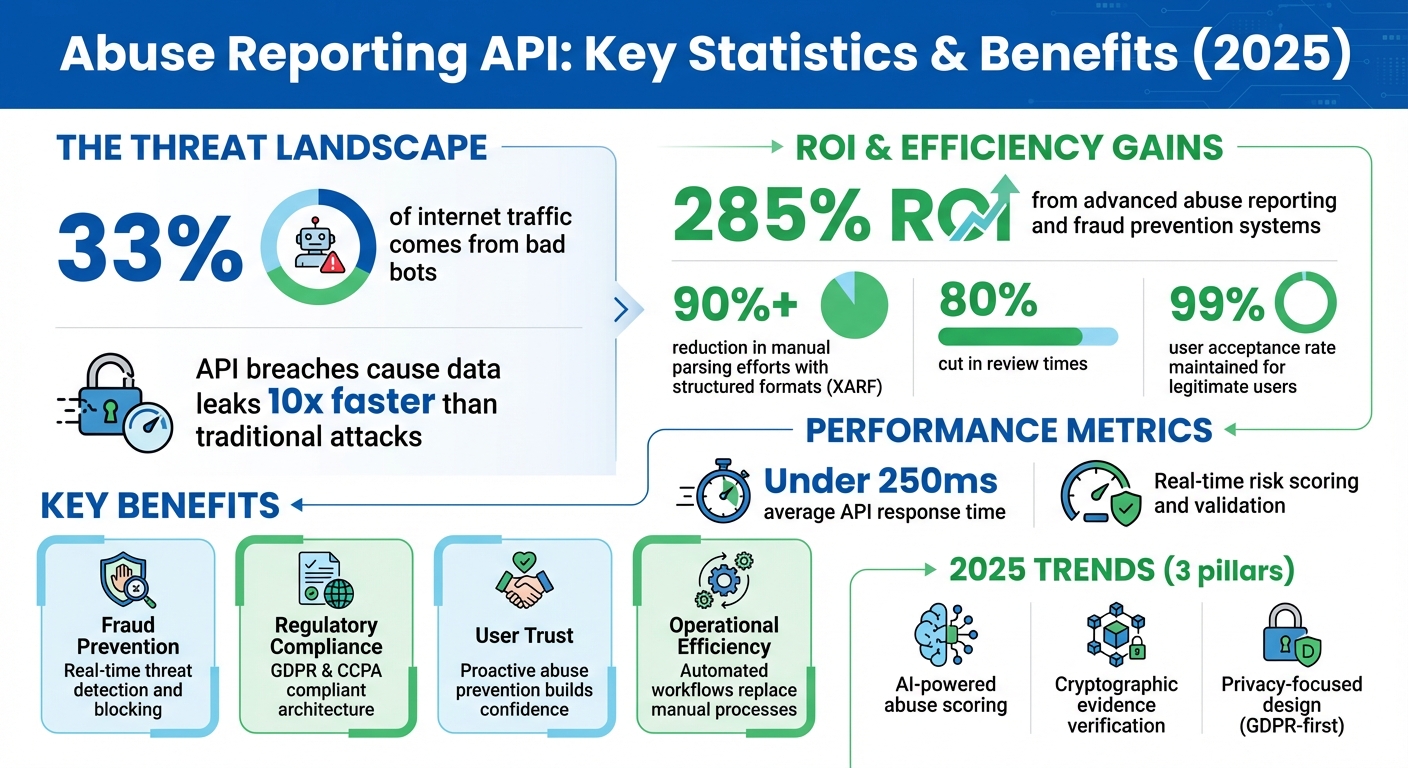
Abuse Reporting API Benefits and Statistics 2025
Benefits of Integrating Abuse Reporting APIs
Abuse reporting APIs bring measurable advantages, including better ROI, streamlined operations, and stronger security. By integrating these APIs, businesses can bolster security measures, ensure regulatory compliance, and cultivate user trust. In fact, advanced abuse reporting and fraud prevention systems can deliver an impressive ROI of up to 285%. This comes from cutting fraud-related losses, reducing operational expenses, and minimizing chargebacks. Let’s dive into how these benefits translate into fraud prevention, adherence to regulations, and enhanced user confidence.
Preventing Fraud and Abuse
One of the standout advantages of integrating abuse reporting APIs is their ability to prevent fraud and abuse. These APIs work by assessing risks in real time, stopping threats before they can cause damage. For example, during user registration, these systems analyze IP addresses and email data to flag disposable emails, proxies, or known threats. Modern APIs even provide abuse-specific scores - like promo_abuse or payment_abuse - allowing businesses to tailor their responses to specific risks.
Platforms using structured formats like XARF can reduce manual parsing efforts by over 90% and cut review times by up to 80%. This means security teams can focus on more complex investigations instead of sifting through unstructured email complaints. At the same time, these APIs help maintain high user acceptance rates - up to 99% - by minimizing friction for legitimate users.
"AbuseReport.org has elevated our app security. Its precise insights into abuse data have allowed us to prevent potential damage early and significantly reduce payment chargebacks."
- James Anderson, Software Engineer
APIs also support both synchronous and asynchronous workflows. Synchronous responses instantly block fraudulent signups based on risk scores, while asynchronous webhooks can trigger manual reviews, which help refine the overall security model.
Meeting Privacy Regulations
Abuse reporting APIs are built with privacy laws like GDPR and CCPA in mind. For instance, XARF v4 separates evidence from personally identifiable information (PII) and supports redacted data formats. Some API providers go a step further by avoiding query logging entirely, ensuring user data remains protected.
An evidence-first approach uses cryptographic verification to maintain a verifiable chain of custody, ensuring reports meet legal requirements. These APIs also offer configurable data retention settings, helping organizations comply with storage limitation rules outlined in privacy regulations.
"XARF v4 represents a complete evolution of abuse reporting, designed for the challenges of the modern internet... with a GDPR-friendly architecture."
- XARF Documentation
Abuse APIs also simplify compliance with DMCA requirements by providing structured fields for copyright details, ensuring that takedown requests meet legal standards. By shifting to machine-readable JSON formats, these APIs replace error-prone manual processes with automated, auditable workflows.
Building User Trust and Platform Reputation
Proactively addressing abuse not only enhances security but also builds customer trust and strengthens your platform’s reputation. Real-time validation during user signups prevents bad actors from entering the system, creating a safer environment for legitimate users. Quick threat responses further boost user confidence.
Standardized reporting acts as a universal language, enabling smooth collaboration between service providers, security teams, and law enforcement. This interconnected approach allows threats detected on one platform to be quickly shared with others, creating a network effect that benefits everyone. For instance, the XARF v4 standard covers 32 specialized abuse types across 7 categories, addressing threats ranging from phishing to DDoS attacks.
Additionally, brand monitoring tools integrated with abuse APIs help platforms track their public reputation. These tools can flag if a platform is associated with abusive experiences, allowing for quick remediation before SEO rankings or public perception take a hit.
"Since adopting AbuseReport.org's API, we've noticed a significant drop in [spam user registrations]. What impressed us the most is how quickly suspicious users are identified and flagged by our system."
- Elias Taylor, App Developer
Features and Capabilities of AbuseReport.org API

The AbuseReport.org API provides a powerful, real-time solution for detecting and preventing digital abuse. With detailed insights into IPs and emails and a lightning-fast average response time of under 250ms, it integrates effortlessly into high-traffic systems while maintaining peak performance. Below, we’ll explore the API's key features, integration tools, and pricing structure.
Core API Features
The API is designed for fast, automated threat detection and response. It generates real-time risk scores for IP addresses and emails, making user validation quick and efficient. Beyond basic abuse data, the API offers extensive IP intelligence, including:
- Geolocation details: Country, city, and zip code.
- Network information: ASN details, ISP/organization data, and abuse contact information.
- Identity masking detection: Identifies VPNs, proxies, and hosting provider IPs.
For email checks, the API performs deep validation by analyzing MX records, SPF, and DMARC configurations. It also flags disposable email addresses, helping reduce SMTP bounces and identifying risky registrations.
A universal "Check" endpoint streamlines input handling by automatically identifying whether the input is an email or an IP address. For more precise validation, you can specify the type using a query parameter (e.g., ?type=email|ip_address). Responses are delivered in a standardized JSON format, and authentication is managed securely with Bearer tokens, aligning with the platform's "Privacy by Default" principles.
SDK and No-Code Tool Support
To make integration as smooth as possible, AbuseReport.org provides libraries for PHP, Python, and JavaScript, along with no-code tools for added flexibility. For example, you can link your Stripe account to automatically report payment disputes as abuse cases. Additionally, a Telegram bot is in development, allowing users to query the API through chat commands.
The platform's "No Rate Limits" policy (aside from your monthly quota) eliminates the need for pagination or throttling. Plus, requests to non-data endpoints don’t count against your quota, ensuring uninterrupted performance.
Pricing and Plan Comparison
AbuseReport.org uses a tiered pricing structure based on monthly request quotas, which reset on the first day of each month. For instance, the Business plan includes 50,000 requests per month, offering a practical balance for SaaS applications and digital services. If you exceed your quota, the API returns a 429 error, signaling the need for a plan upgrade. A user-friendly account dashboard lets you track your usage and remaining quota in real time.
Step-by-Step Integration Guide
Integrating the AbuseReport.org API into your platform is a simple process, thanks to its clear documentation and responsive design. Here's how to get started.
Setting Up API Authentication
The API uses a Bearer token for authentication, which needs to be included in every HTTP request header. To get your unique API key, log in to your AbuseReport.org account and go to the account page. Once you have the key, include it in the header like this: Authorization: Bearer {YOUR_API_KEY}.
If your API key is incorrect or lacks the proper permissions, the API will respond with a 403 Unauthorized status code. To keep track of your usage, you can query the base endpoint at GET https://api.abusereport.org to check the requests_usage and requests_remaining fields. These queries won’t count against your quota.
For security, avoid hardcoding your API key. Instead, store it securely on your server.
Making Your First API Request
Once authentication is set, you can test your connection. Start with a simple GET request to the base URL, which will return your account details, plan type, and usage limits. Here's an example using cURL:
curl -X GET https://api.abusereport.org \
  -H "Authorization: Bearer {YOUR_API_KEY}"
A successful response will include "success": true along with details like requests_remaining. After confirming the connection, you can use the Check endpoint to gather abuse insights for an email or IP address:
curl -X GET https://api.abusereport.org/check/192.0.2.1 \
  -H "Authorization: Bearer {YOUR_API_KEY}"
The Check endpoint automatically identifies whether the input is an email or IP address. If needed, you can enforce strict validation by adding the ?type=email|ip_address parameter. If you exceed your monthly quota, you’ll get a 429 Too Many Requests error, indicating it’s time to upgrade your plan.
Implementing Email and IP Validation
To enhance your platform's security, integrate email and IP validation using the API.
For email validation, the API checks MX records, SPF and DMARC configurations, and flags disposable email addresses. This helps minimize SMTP bounces and prevents fraudulent signups. Here's a Python example:
import requests

api_key = "YOUR_API_KEY"
email = "[email protected]"
url = f"https://api.abusereport.org/check/{email}"
headers = {"Authorization": f"Bearer {api_key}"}

response = requests.get(url, headers=headers)
data = response.json()

if data.get("has_reports"):
    print(f"Warning: {email} has abuse reports. Risk score: {data.get('risk_score')}")
For IP validation, the API provides details like geolocation (country, city), ASN data, and flags for proxies, VPNs, or hosting providers. Use the proxy and hosting flags to differentiate between regular users and potential bots. Here's a JavaScript example:
const apiKey = "YOUR_API_KEY";
const ipAddress = "203.0.113.45";
const url = `https://api.abusereport.org/check/${ipAddress}`;

fetch(url, {
  headers: { "Authorization": `Bearer ${apiKey}` }
})
.then(response => response.json())
.then(data => {
  if (data.proxy || data.hosting) {
    console.log("Detected: proxy or hosting provider");
  }
});
Both email and IP checks return a risk_score, allowing you to assess users programmatically. Be sure to handle HTTP status codes like 403 (Unauthorized) and 429 (Quota exceeded) to ensure smooth error management.
Best Practices and Security Considerations
Integrating an abuse reporting API requires careful planning to ensure it’s secure, reliable, and performs well under pressure. Here’s how to create a solid integration that safeguards your platform and users.
Error Handling and Monitoring
Good error handling is crucial to keep small hiccups from becoming big problems. When the API throws an error, your system should handle it gracefully, avoiding crashes or leaks of sensitive information. For example, if the API responds with an error, show users a simple message like, "We're experiencing technical difficulties. Please try again later." Internally, however, log the full error details for debugging.
Here’s a quick guide to common HTTP status codes and how to handle them:
| HTTP Code | Meaning | Recommended Action |
|---|---|---|
| 200 OK | Request successful | Use the returned report identifier or data |
| 400 Bad Request | Invalid or missing parameters | Check the response for validation issues |
| 403 Unauthorized | Invalid API key | Verify your Bearer token and permissions |
| 429 Too Many Requests | Monthly limit reached | Upgrade your plan or wait for the reset |
| 500 Internal Error | Server-side issue | Retry with exponential backoff logic |
To avoid hitting your API limits, monitor the requests_remaining value closely. Set up alerts when usage hits 80% of the limit so you can upgrade your plan or throttle requests before disruptions occur. AbuseReport.org resets quotas on the first of each month, so having internal request throttling in place can help you manage usage effectively.
Addressing OWASP API Security Risks

Beyond error handling, securing your API is critical. Start by protecting your API keys - never hardcode them in your source code, push them to version control, or include them in URLs. Instead, store them securely on your server and pass them in the HTTP header as Bearer tokens.
To minimize risk, restrict API key usage to specific IP addresses or functionalities. Assign unique keys to different applications or team members, making it easier to trace activity and isolate breaches. Rotate keys regularly and delete any that are no longer in use.
Validate all input parameters rigorously. Use regex or strict data types to check for proper length, range, and format, reducing the risk of injection attacks. For multi-step processes, ensure each step is validated server-side to maintain the correct sequence. Additionally, rate limiting is essential to defend against denial-of-service attacks.
Always use HTTPS to protect API keys and data during transmission. Strengthen responses with security headers like:
Cache-Control: no-storeto prevent caching of sensitive data.Strict-Transport-Securityto enforce HTTPS connections.X-Content-Type-Options: nosniffto block MIME type confusion.
With these security measures in place, you can focus on optimizing your API for performance.
Optimizing for Performance and Scalability
Handling a high volume of abuse reports demands smart optimization. Instead of making a separate API call for every user action, batch requests whenever possible. Cache results for frequently checked data, like email addresses or IP ranges, to cut down on redundant API traffic and speed up response times.
Consider adaptive rate limiting for API endpoints. Instead of static IP-based limits, use session identifiers - like JWT claims, cookies, or authorization tokens - to track and analyze usage per session. For example, you could allow free-tier users up to 5 requests per minute, while premium-tier users get up to 50.
When rolling out new rate limits, start in "log" mode to monitor violations and adjust thresholds before enforcing blocks. Keep an eye on patterns in your logs, such as repeated requests from a single session or access from multiple geographic locations, to identify potential abuse.
Conclusion
In 2025, integrating abuse reporting APIs has become a must for platforms managing registrations, payments, or user-generated content. The shift from manual, reactive processes to automated, proactive validation has reshaped how businesses approach security. By embedding real-time risk assessment into critical points like user sign-ups and checkouts, platforms can stop threats like chargebacks, spam, or data breaches before they escalate. This evolution builds on earlier strides in automated risk management.
The adoption of structured data formats such as XARF v4 has streamlined abuse reporting, making it faster and more actionable while cutting down on manual workloads. Paired with robust validation tools - like detecting disposable emails or identifying VPN usage - platforms can effectively distinguish genuine users from automated threats.
Modern abuse APIs provide lightning-fast insights, often responding in under 250 milliseconds. To maintain both security and performance, it’s critical to implement smart strategies like batching requests, caching common data, and keeping an eye on monthly usage quotas to prevent service disruptions.
By adhering to privacy regulations and embracing a "privacy by default" approach, platforms not only enhance security but also build trust with their users. APIs that avoid logging sensitive query data demonstrate a commitment to protecting user information while maintaining strong fraud defenses. Striking this balance between privacy and security is what sets trusted platforms apart from those users avoid.
Start by incorporating email validation at registration, then layer on IP risk scoring at payment gateways. Each additional layer strengthens your defenses, ensuring your platform keeps pace with evolving threats.
FAQs
How do abuse reporting APIs improve user trust and platform reputation?
Abuse reporting APIs play a crucial role in building user trust and enhancing a platform's reputation. They provide efficient tools for identifying, reporting, and addressing harmful content, enabling platforms to respond swiftly to abuse reports. This demonstrates a clear commitment to user safety and fosters a transparent environment where users feel their concerns are acknowledged and taken seriously.
These APIs simplify the reporting process by standardizing how incidents are organized and managed. This streamlined approach allows platforms to address threats more effectively, curbing the spread of harmful content. As a result, platforms not only create a safer digital environment but also reinforce their reliability, making them more appealing to users and cultivating lasting trust.
What privacy factors should I consider when integrating abuse reporting APIs?
When working with abuse reporting APIs, safeguarding user privacy and adhering to regulations like GDPR or local laws is essential. For instance, information such as IP addresses or user identifiers might qualify as personal data. This means any collection or processing must align with strict privacy guidelines.
To maintain security, implement secure authentication methods like API keys or OAuth tokens to block unauthorized access. Follow data minimization practices by only gathering the information needed for detecting and reporting abuse. Additionally, be upfront with users about what data is being collected and how it will be used.
Your system should also allow users to access, correct, or delete their data in compliance with privacy laws. This approach not only protects user rights but also fosters trust in your abuse reporting process.
How can businesses evaluate the ROI of using abuse reporting APIs?
Businesses can measure the return on investment (ROI) of abuse reporting APIs by analyzing a few critical metrics. Start by looking at the reduction in abuse incidents and how efficiently reports are resolved. For instance, tracking decreases in fraudulent activities or malicious traffic can provide clear evidence of the API's impact. Additionally, automation and quicker response times can translate into noticeable cost savings by cutting down on manual labor.
Another key area to evaluate is the effect on customer trust and satisfaction. Creating a safer digital environment often leads to higher user retention and boosts brand reputation. There's also the financial upside of avoiding expensive breaches or legal troubles, which the API helps prevent by effectively detecting and managing abuse.
By combining insights on decreased incidents, operational cost savings, and improved customer trust, businesses can clearly see how these APIs contribute to stronger security and greater efficiency.